Your NEET scorecard is open. There’s a number at the top — your marks — and a much smaller line near the bottom that most students skim right past: the qualifying cutoff. That small line is actually the only thing standing between you and BAMS, BHMS, BUMS, or BSMS counselling this year. Let’s go through it the way a senior would explain it to you over chai, not the way a government notification would.
Table of Contents
First Things First — What Did NTA Actually Announce?
On 16 July 2026, alongside the Re-NEET result, NTA released the official qualifying marks. Here they are, exactly as published:
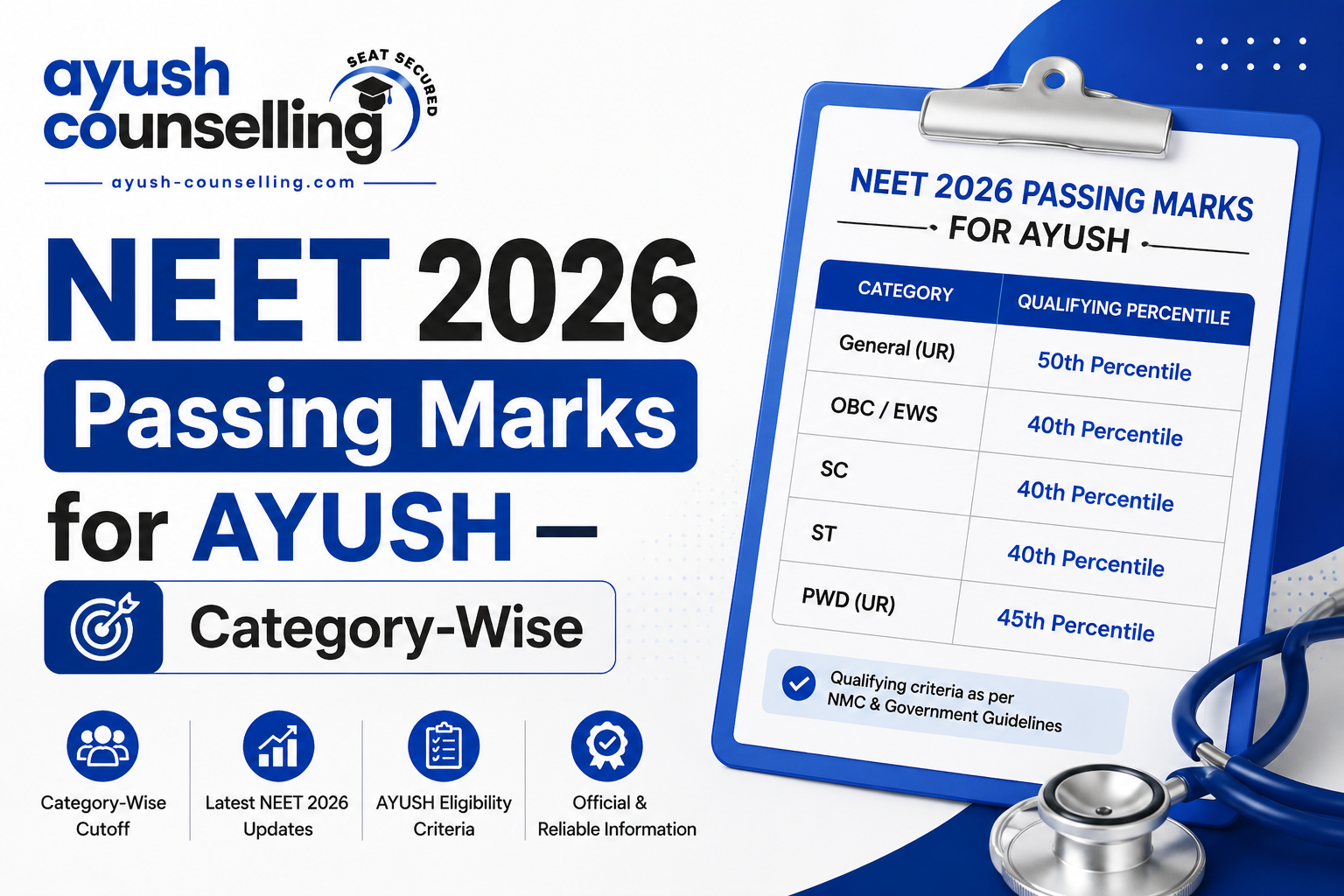
| Category | Qualifying Percentile | Qualifying Marks (out of 720) |
|---|---|---|
| General (UR) / EWS | 50th percentile | 715 – 213 |
| OBC / SC / ST | 40th percentile | 212 – 177 |
| General-PwBD | 45th percentile | 212 – 194 |
| OBC-PwBD / SC-PwBD | 40th percentile | 193 – 177 |
| ST-PwBD | 40th percentile | 191 – 178 |
That’s it. That’s the entire “passing marks” answer. If your score sits inside your category’s range above, you’ve cleared the bar for BAMS, BHMS, BUMS, and BSMS counselling — the same qualifying score applies to MBBS, BDS, and every other NEET-based course, since there’s no separate AYUSH entrance exam.
“Wait, 213 Marks Is Enough to Qualify?” — Yes, But Read This Next Part Carefully
This is where almost every student trips up, so let’s slow down here specifically.
Qualifying simply means you cleared the minimum bar to be allowed into counselling. It does not mean 213 marks gets you a seat anywhere close to a government BAMS college. Think of it like a driving test — passing gets you a license, it doesn’t hand you a car. The real number that decides whether you actually land a specific college is called the admission cutoff, or the closing rank, and it’s set separately by AACCC and each state’s counselling authority after every round, based on how many seats exist and how many students want them.
So yes — 213 marks technically qualifies a General category student for AYUSH counselling. But a government BAMS seat at that score is extremely unlikely. A private BAMS seat becomes realistic somewhere well above that floor. This is genuinely the single most important distinction on this entire page.
Why Did the Passing Marks Jump So Much From Last Year?
If you compared notes with a senior who took NEET in 2025, their qualifying marks probably sound completely different from yours — and that’s expected, not a mistake.
| Category | NEET 2025 Qualifying Marks | NEET 2026 Qualifying Marks | Change |
|---|---|---|---|
| General/EWS | 686 – 144 | 715 – 213 | Sharp rise |
| OBC/SC/ST | 143 – 113 | 212 – 177 | Sharp rise |
| UR/EWS-PwBD | 143 – 127 | 212 – 194 | Sharp rise |
The percentile stays fixed every single year — 50th for General/EWS, 40th for reserved categories, set permanently by the National Medical Commission. What changes is the marks that correspond to that percentile, and that depends entirely on how the whole candidate pool performed. NEET 2025’s paper was reported as tougher and application-heavy, which pulled everyone’s scores down, so the 50th percentile landed at a lower mark.
NEET 2026’s Re-Exam paper was comparatively moderate, pushing the whole distribution up — so the 50th percentile this year landed at a much higher mark. Same rule, different number, because the paper itself was different.
What Score Do You Actually Need for a Real AYUSH Seat?
Here’s the part your scorecard won’t tell you directly — a realistic, category-wise sense of where BAMS admission cutoffs (not qualifying cutoffs) tend to land:
| Category | Government BAMS — Realistic Score | Private BAMS — Realistic Score |
|---|---|---|
| General | 400–480+ | 250–380 |
| OBC | 380–450 | 220–350 |
| SC | 320–400 | 180–300 |
| ST | 300–380 | 170–280 |
| EWS (scholarship) | 400–470 | 250–370 |
| PwD | 300–400 | 170–280 |
Given that 2026’s overall scoring pattern ran noticeably higher than 2025’s, treat the top end of these ranges as more likely than the bottom this year — a college that closed at 420 last year may realistically close closer to 450-470 this admission cycle.
A Question Worth Asking Yourself Right Now
Does your score clear your category’s qualifying mark from the table above? If yes, you’re in the game — register for both AACCC and your state’s AYUSH counselling portal without hesitation. If your score falls just short, don’t assume it’s over; double-check your exact category bracket (Gen-PwBD and OBC-PwBD have different, lower thresholds than plain General or OBC), and confirm using your actual scorecard rather than a rough estimate, since even a few marks’ difference in how you self-calculated your score can change this answer.
Common Confusions, Cleared Up
“My friend qualified with fewer marks than me — how?”
Different category, different percentile requirement. A 200-mark OBC candidate and a 200-mark General candidate are in entirely different positions — the OBC candidate cleared their bar comfortably, while a General candidate at 200 marks wouldn’t qualify at all this year, since the General floor is 213.
“I cleared the qualifying cutoff — am I guaranteed a BAMS seat?”
No. Qualifying gets you into counselling. Your actual seat depends on your rank, your category, how many seats exist in your target colleges, and how many other candidates are competing for the same seats in that specific round.
“Does the qualifying cutoff differ by state?”
No — the qualifying cutoff released by NTA is uniform nationwide. What differs by state is the admission cutoff, since each state runs its own counselling with its own seat matrix and demand.
“I’m PwBD but also OBC — which cutoff applies to me?”
The OBC-PwBD specific range (193–177 marks this year), not the general OBC range or the general PwBD range — combined-category candidates have their own distinct bracket.
Quick Self-Check Table
| Your Category | Did You Clear It? (2026 Qualifying Marks) |
|---|---|
| General / EWS | 213 or above |
| OBC / SC / ST | 177 or above |
| General-PwBD | 194 or above |
| OBC-PwBD / SC-PwBD | 177 or above |
| ST-PwBD | 178 or above |
If your marks meet or exceed your row here, you’re officially eligible for AYUSH counselling in 2026 — the next step is registering on AACCC (aaccc.gov.in) and your state’s AYUSH portal.
FAQ
Q1. What are the NEET 2026 passing marks for General category AYUSH admission?
213 marks out of 720, based on the 50th percentile, as officially released by NTA on 16 July 2026.
Q2. What are the passing marks for OBC, SC, and ST for AYUSH 2026?
177 marks out of 720, based on the 40th percentile — the same qualifying floor applies uniformly to OBC, SC, and ST categories.
Q3. Are NEET passing marks the same for BAMS, BHMS, BUMS, and MBBS?
Yes. There’s no separate AYUSH entrance exam — the same NEET UG qualifying cutoff applies across MBBS, BDS, and all AYUSH courses.
Q4. Is qualifying NEET enough to get a BAMS seat?
No. Qualifying only makes you eligible for counselling. Actual seat allotment depends on the much higher admission cutoff, which varies by college, category, quota, and round.
Q5. Why are NEET 2026 passing marks higher than 2025?
The qualifying percentile stayed the same, but this year’s Re-Exam paper was comparatively easier than 2025’s tougher paper, pushing the marks needed to hit that same percentile significantly higher.
Disclaimer: Qualifying marks are fixed by NTA for 2026 and won’t change, but admission (closing) cutoffs are set separately by AACCC and state counselling authorities after each round. Always verify your exact scorecard details at neet.nta.nic.in and check current admission cutoffs on aaccc.gov.in or your state’s AYUSH portal before making counselling decisions.
- UP AYUSH Counselling 2026: Round 1 Schedule, Dates & Admission Process
- AACCC AYUSH Counselling 2026-27: Complete Schedule, Dates & Latest Updates
- Santushti Ayurvedic Medical College & Hospital, Mirzapur — BAMS Admission 2026: Fees, Seats, Cutoff & Full Details
- AYUSH Counselling Live Status 2026
- Ishan Ayurvedic Medical College and Research Centre, Greater Noida — BAMS Admission 2026
- Guru Gorakshanath Institute of Medical Sciences Gorakhpur — BAMS Admission & AYUSH Counselling 2026 Complete Guide