
UP AYUSH Counselling 2026 is the state-level admission process for BAMS, BHMS, BUMS, and BSMS seats in Uttar Pradesh, run by the Department of AYUSH, Government of UP, in coordination with NIC, through upayushcounseling.upsdc.gov.in.
It’s based entirely on your NEET UG 2026 Re-Exam score — the original May 3, 2026 exam was cancelled and re-conducted on June 21, 2026, with the final result declared on July 16, 2026.
Registration costs ₹2,000 (non-refundable, all categories), plus a security deposit of ₹20,000 for government colleges or ₹50,000 for private colleges.
UP runs one of India’s largest AYUSH seat pools — 82 BAMS colleges with 6,213 seats, 13 BHMS colleges with 1,262 seats, and 15 BUMS colleges with 815 seats — split 85% state quota and 15% All India Quota (AACCC).
Because this year’s calendar shifted due to the re-exam, expect registration to open around early August 2026, roughly six weeks later than a typical cycle.
The Re-Exam Effect on Your Counselling Timeline
If you’ve been reading older UP AYUSH guides, you’ve probably seen dates like “NEET result: June 14, 2026” or “Counselling starts: July 2026.” Those were reasonable estimates based on a normal exam cycle — but 2026 wasn’t a normal cycle.
NEET UG 2026 was originally conducted on May 3, 2026. Following integrity concerns, the National Testing Agency ordered a nationwide re-exam, held on June 21, 2026.
The provisional answer key followed on June 25, the objection window ran through June 28, and after a final OMR/response challenge window (July 13–15), NTA declared the official result on July 16, 2026.
This is roughly a six-week delay compared to a standard NEET cycle, and it pushes every downstream AYUSH counselling date back proportionally.
If you’re planning around dates from a 2025-pattern article, mentally shift everything forward by about a month to a month and a half.
UP AYUSH Counselling 2026 — Key Highlights at a Glance
| Detail | Information |
|---|---|
| Conducting Body | Department of AYUSH, Govt. of Uttar Pradesh + NIC |
| Official Website | upayushcounseling.upsdc.gov.in |
| Courses Covered | BAMS, BHMS, BUMS, BSMS |
| Admission Basis | NEET UG 2026 Re-Exam score only |
| NEET Re-Exam Date | June 21, 2026 |
| NEET Result Declared | July 16, 2026 |
| State Quota Seats | 85% of govt. college seats + 100% of private college seats |
| AIQ Seats (AACCC) | 15% of govt. college seats (separate, parallel process) |
| Registration Fee | ₹2,000, non-refundable, all categories (covers Round 1, 2, and Mop-Up) |
| Security Deposit | ₹20,000 (Govt. colleges only) / ₹50,000 (Private, or Govt.+Private combined) |
| Mode | Fully Online |
| Counselling Rounds | Round 1, Round 2, Mop-Up Round, Stray Vacancy Round(s) |
| Total UP AYUSH Seats | 8,290 across BAMS, BHMS, BUMS |
UP AYUSH Counselling 2026 — Realistic Dates (Post Re-Exam)
Because the official 2026–27 bulletin is still being finalized following the re-exam, here’s a realistic, re-exam-adjusted timeline built from NTA’s confirmed schedule plus UP AYUSH’s typical processing gap:
| Event | Date |
|---|---|
| NEET UG 2026 original exam | May 3, 2026 |
| NEET UG 2026 Re-Exam | June 21, 2026 |
| Final answer key + Result declared | July 16, 2026 |
| UP AYUSH official notification (expected) | Late July – Early August 2026 |
| Round 1 registration opens (expected) | Early-mid August 2026 |
| Round 1 registration closes (expected) | Late August 2026 |
| State merit list (expected) | Late August – Early September 2026 |
| Round 1 choice filling & locking (expected) | September 2026 |
| Round 1 seat allotment result (expected) | Mid-late September 2026 |
| Document verification / reporting (expected) | September–October 2026 |
| Round 2 registration & allotment (expected) | October 2026 |
| Mop-Up Round (expected) | November 2026 |
| Stray Vacancy Round(s) (expected) | November–December 2026 |
| Academic session begins (expected) | December 2026 – January 2027 |
NEET UG 2026 Result — The Numbers That Actually Feed Into Your Counselling
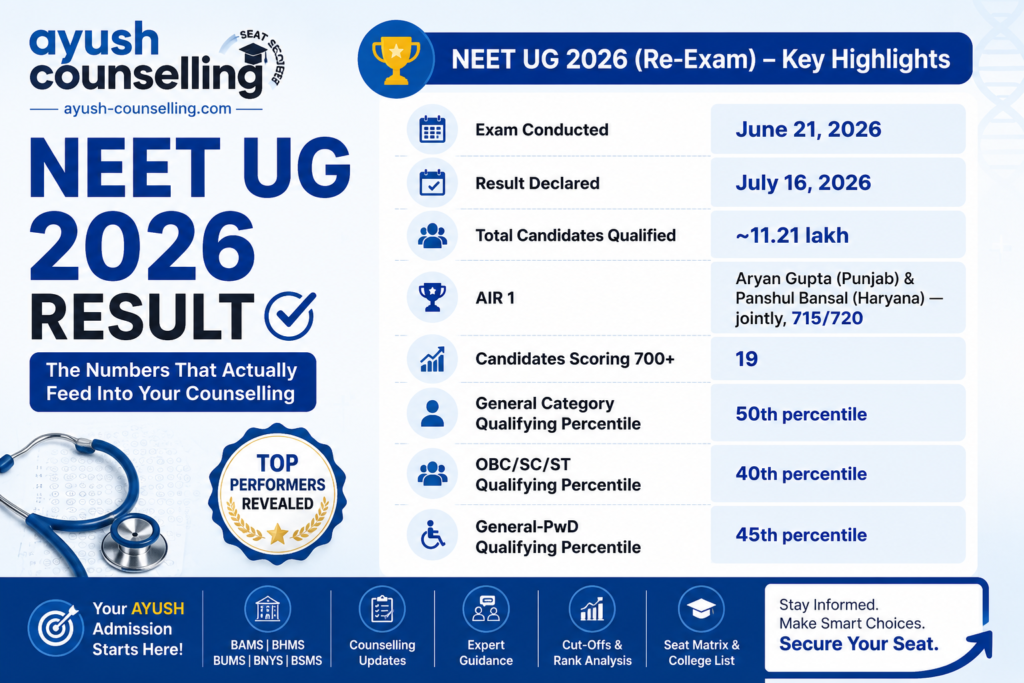
Since your entire AYUSH eligibility flows from this result, here’s exactly what was declared on July 16, 2026:
| Metric | NEET UG 2026 (Re-Exam) |
|---|---|
| Exam conducted | June 21, 2026 |
| Result declared | July 16, 2026 |
| Total candidates qualified | ~11.21 lakh |
| AIR 1 | Aryan Gupta (Punjab) & Panshul Bansal (Haryana) — jointly, 715/720 |
| Candidates scoring 700+ | 19 |
| General category qualifying percentile | 50th percentile |
| OBC/SC/ST qualifying percentile | 40th percentile |
| General-PwD qualifying percentile | 45th percentile |
Why this matters specifically for AYUSH aspirants: your BAMS/BHMS/BUMS eligibility is governed by this same NEET UG score and the same percentile cutoffs used for MBBS/BDS. There’s no separate AYUSH entrance exam — your Re-Exam result is your only ticket into UP AYUSH counselling.
2026 vs 2025: How This Year’s Result Compares
Understanding the difference between this year’s paper and last year’s matters because cutoffs move with overall performance, not in isolation.
| Metric | NEET UG 2025 | NEET UG 2026 (Re-Exam) |
|---|---|---|
| Exam date | May 4, 2025 | June 21, 2026 (re-conducted) |
| Result declared | June 14, 2025 | July 16, 2026 |
| Total appeared | 22,09,318 | ~20 lakh |
| Total qualified | 12,36,531 | ~11.21 lakh |
| Highest score | 686/720 (Mahesh Kumar, Rajasthan) | 715/720 (jointly, Aryan Gupta & Panshul Bansal) |
| Students scoring 700+ | Effectively none | 19 |
| General cutoff (marks) | 686–144 | Rose compared to 2025 |
| Paper difficulty (reported) | Tougher, application-heavy | Moderate |
What this means practically for UP AYUSH choice filling: 2025’s tougher paper pulled the entire score distribution down, so cutoffs — including UP AYUSH BAMS/BHMS/BUMS closing scores — were comparatively lower across every category. 2026’s moderate Re-Exam paper pushed scores up across the board, which means this year’s UP AYUSH closing scores are likely to run higher than last year’s at every round. Don’t use last year’s exact cutoff marks as your target — use them as a relative trend indicator, and expect to need somewhat more marks to land in the same college this year.
Eligibility Criteria for UP AYUSH Counselling 2026
| Criteria | Requirement |
|---|---|
| Nationality | Indian citizen |
| Domicile (State Quota) | UP permanent residency required for government college state-quota seats |
| Domicile (Private colleges) | Not mandatory — out-of-state candidates can apply |
| Minimum age | 17 years as of December 31, 2026 |
| Upper age limit | None (per current NCISM/NCH guidelines) |
| Educational qualification | Class 12 (10+2) with Physics, Chemistry, Biology/Biotechnology + English |
| Minimum PCB marks — General | 50% |
| Minimum PCB marks — OBC (NCL) | 40% |
| Minimum PCB marks — SC/ST | 40% |
| Minimum PCB marks — PwD (General) | 45% |
| Minimum PCB marks — PwD (SC/ST/OBC) | 40% |
| NEET UG qualification | Mandatory — no separate state entrance exam |
State Quota vs All India Quota — The Distinction That Confuses Everyone
| Feature | State Quota (UP) | All India Quota (AACCC) |
|---|---|---|
| Authority | Department of AYUSH, UP + NIC | AACCC, Ministry of AYUSH |
| Portal | upayushcounseling.upsdc.gov.in | aaccc.gov.in |
| Seat share | 85% govt. + 100% private | 15% of govt. college seats |
| Domicile required | Yes, for govt. seats | No |
| Registration fee | ₹2,000, all categories | ₹1,000 (General/OBC/EWS) / ₹500 (SC/ST/PwBD) |
| Key institutions included | All UP state govt. & private colleges | BHU, National Institutes, Deemed Universities |
Can you apply to both? Yes. They’re entirely separate, parallel processes with separate fees, separate registrations, and separate seat pools. Registering for one doesn’t affect your eligibility for the other — most serious UP-based aspirants register on both to maximize their chances.
UP AYUSH Seat Matrix 2026 — Course-Wise Breakdown
| Course | Colleges | Total Seats | Approx. Govt. Seats | Approx. Private Seats |
|---|---|---|---|---|
| BAMS (Ayurveda) | 82 | 6,213 | ~563 | ~5,650 |
| BHMS (Homeopathy) | 13 | 1,262 | ~979* | ~283 |
| BUMS (Unani) | 15 | 815 | ~150 | ~665 |
| Total | 110 | 8,290 | ~1,692 | ~6,598 |
*Note: BHMS government seat figures vary by source between roughly 400–979 depending on whether aided/private-grant colleges are counted as government; always verify the exact split in the current year’s official seat matrix.
What this tells you instantly: government seats make up roughly 15–20% of UP’s total AYUSH pool. If a government seat is your specific goal, your real competitive pool is a small fraction of the 8,290 headline number — plan your choice list accordingly.
Registration Fee & Security Deposit — What’s Refundable, What’s Not
| Fee Component | Amount | Refundable? |
|---|---|---|
| Registration fee (all categories) | ₹2,000 | No — covers Round 1, Round 2, and Mop-Up in one payment |
| Security deposit — Government college only | ₹20,000 | Conditionally — depends on exit round and timing |
| Security deposit — Private college / Both | ₹50,000 | Conditionally |
| Re-registration fee (if re-entering Round 2/Mop-Up after skipping) | ₹1,000 | No |
The rule that matters most: choice filling is unlocked only after the security deposit is paid — you cannot fill or lock preferences without it. If you want both government and private options open, you must pay the ₹50,000 tier; paying only ₹20,000 restricts your list to government colleges alone.
Reservation Policy — UP AYUSH State Quota 2026
| Category | Reservation % |
|---|---|
| General / Unreserved (UR) | ~40% |
| Other Backward Classes (OBC) | 27% |
| Scheduled Caste (SC) | 21% |
| Economically Weaker Section (EWS) | 10% |
| Scheduled Tribe (ST) | 2% |
| PwD (horizontal, across all categories) | 5% |
| Female candidates (horizontal, where applicable) | 30% |
Important rules: OBC Creamy Layer candidates are not eligible for OBC reservation and are treated as General. EWS eligibility depends on income and property criteria set by the UP government. Category certificates must be issued by competent UP authorities. Reserved seats left unfilled in a round may convert to other categories in later rounds (for example, unfilled ST seats converting to SC in a subsequent round).
Step-by-Step UP AYUSH Counselling Process 2026
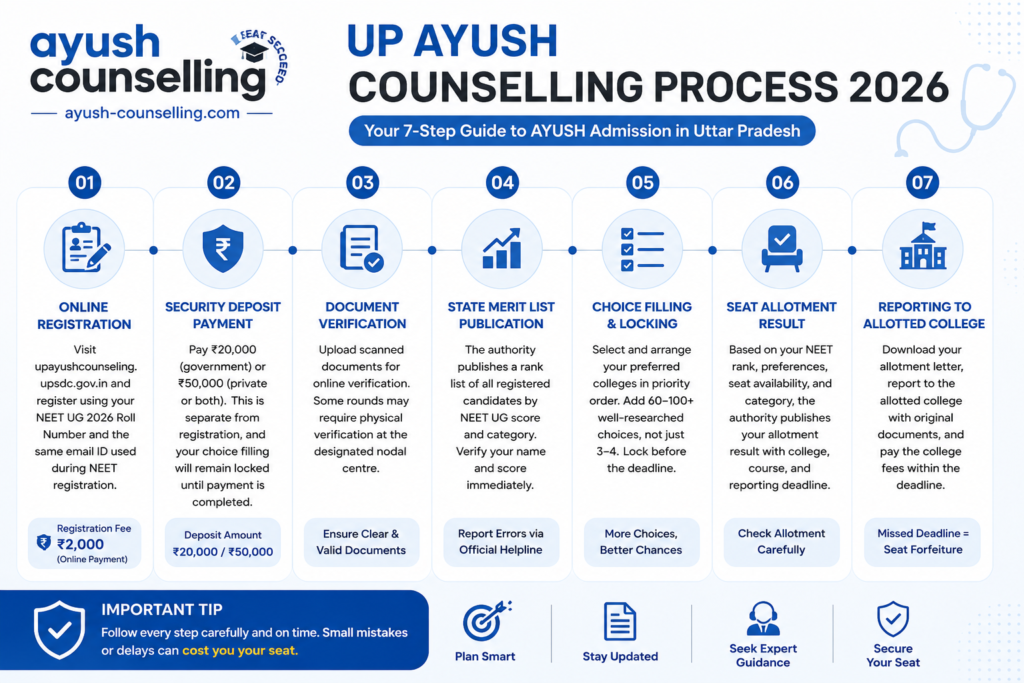
Step 1 — Online Registration. Visit upayushcounseling.upsdc.gov.in and register using your NEET UG 2026 Roll Number and the same email ID used during NEET registration. Pay the ₹2,000 registration fee via debit card, credit card, net banking, or UPI.
Step 2 — Security Deposit Payment. Pay ₹20,000 (government only) or ₹50,000 (private, or both). This is a separate payment from registration, and choice filling stays locked until it’s completed.
Step 3 — Document Verification. Upload scanned documents for online verification; some rounds also require physical verification at a designated nodal centre. Ensure documents are clear, correctly formatted (PDF/JPEG as specified), and match your registration details exactly.
Step 4 — State Merit List Publication. The authority publishes a rank list of all registered candidates by NEET UG score and category. Verify your name and score immediately — errors need to be flagged through official helpline channels right away.
Step 5 — Choice Filling and Locking. Select and arrange your preferred colleges in priority order. There’s no limit on how many colleges you can add — filling 60-100+ well-researched choices, not just 3-4, significantly improves your odds. Lock before the deadline — an unlocked list is treated as withdrawal from that round.
Step 6 — Seat Allotment Result. Based on your NEET rank, filled preferences, seat availability, and category, the authority publishes your allotment — showing your allotted college, course, and reporting deadline.
Step 7 — Reporting to the Allotted College. Download your allotment letter, report within the deadline with all original documents, and pay college fees. Missing the deadline means automatic seat forfeiture with no second chance in that round.
Counselling Rounds Explained
| Round | Who’s Eligible | Key Notes |
|---|---|---|
| Round 1 | All registered candidates | Free Exit typically available if you don’t want to join your allotted seat |
| Round 2 | Non-allotted candidates + those seeking upgrades + fresh registrants | Exit protections narrow significantly from here |
| Mop-Up Round | Only candidates not yet allotted a seat | Candidates satisfied with an existing allotment cannot participate |
| Stray Vacancy Round(s) | Remaining vacant seats | UP has run up to 5 stray rounds in a single cycle historically — don’t assume the process ends quickly |
Documents Required — Complete Checklist
Academic: Class 10 marksheet & certificate, Class 12 marksheet & certificate (PCB proof), NEET UG 2026 admit card, NEET UG 2026 scorecard.
Identity & Residence: UP domicile certificate (mandatory for state quota govt. seats), Aadhaar card or other valid photo ID.
Category/Reservation (if applicable): Caste certificate (SC/ST/OBC), OBC Non-Creamy Layer certificate (check current-year validity requirement, often within 1 year), EWS certificate, PwD certificate (minimum 40% disability, from an authorised medical board).
Other: Recent passport-size photographs, registration and fee payment printouts, allotment letter (at reporting stage), medical fitness certificate.
Pro tip: Prepare 5-6 self-attested photocopies of every document before reporting — colleges routinely ask for multiple sets during admission formalities.
Top Government AYUSH Colleges in Uttar Pradesh
| College Name | Location | Course |
|---|---|---|
| State Ayurvedic College & Hospital | Lucknow | BAMS |
| Rajkiya Ayurvedic College | Varanasi | BAMS |
| Lalit Hari Government Ayurvedic College | Pilibhit | BAMS |
| Rajkiya Rajrishi Tandon Ayurvedic College | Prayagraj | BAMS |
| Government Ayurvedic College | Meerut | BAMS |
| Government Ayurvedic College | Banda | BAMS |
| Rajkiya Govt. Unani Medical College | Prayagraj (Allahabad) | BUMS |
| Naiminath Homoeopathic Medical College | Agra | BHMS |
Special mention — BHU: Banaras Hindu University’s Institute of Medical Sciences offers BAMS seats through AACCC (AIQ), not UP state quota — meaning candidates from any state can apply for BHU’s Ayurveda seats without a UP domicile certificate.
Fee Structure — Government vs Private AYUSH Colleges in UP
| College Type | Annual Tuition | Total Annual Cost (incl. other fees) |
|---|---|---|
| Government | ₹15,000 – ₹30,000 | ₹30,000 – ₹75,000 |
| Private (through counselling) | ₹1,00,000 – ₹2,50,000 | ₹1.5 – ₹3.5 lakh |
| Private (management quota, where applicable) | ₹1,50,000 – ₹3,50,000 | ₹2 – ₹4.5 lakh |
| Deemed Universities | ₹2,00,000+ | ₹3 – ₹6 lakh |
The government-vs-private fee gap in UP is stark — often a 5-10x difference — which is exactly why understanding your realistic government-seat odds (using the filtered category-wise cutoff data below) matters more than the headline seat number.
NEET Cutoff Trends — UP AYUSH (2025 Data, as a Trend Reference for 2026)
Since 2026’s official round-wise cutoffs aren’t published yet, here’s the most recent confirmed reference point — 2025’s closing scores — explicitly flagged as a trend indicator, not a current-year prediction:
BAMS — Government Colleges (State Quota)
| Category | Round 1 Closing (Approx.) | Mop-Up Closing (Approx.) |
|---|---|---|
| General | 480–520 | 440–480 |
| OBC | 440–470 | 400–440 |
| SC | 380–420 | 340–380 |
| ST | 350–400 | 310–360 |
| EWS | 440–470 | 400–440 |
BAMS — Private Colleges (State Quota)
| Category | Round 1 Closing (Approx.) | Mop-Up Closing (Approx.) |
|---|---|---|
| General | 350–420 | 280–350 |
| OBC | 300–370 | 240–300 |
| SC | 250–310 | 200–260 |
Given that 2026's Re-Exam produced a noticeably higher-scoring distribution than 2025 (19 candidates crossed 700 versus effectively none last year), expect 2026's actual closing scores to run somewhat higher than these 2025 figures at every category and round — treat these numbers as a floor for planning, not a ceiling.Choice Filling Strategy — Do This, Not That
Do: Fill as many colleges as realistically possible (60+ where available) — there’s no penalty for a long list, and the allotment system always offers your highest-ranked eligible choice, never a random pick further down. Arrange choices by genuine preference, mix government and private to hedge your bets, and research each college’s location, fee, and reputation before adding it.
Avoid: Filling only 3-4 colleges and hoping for the best. Forgetting to lock your choices — an unlocked list equals non-participation for that round. Waiting until the final hour, when server load and technical issues are common. Paying the ₹20,000 (government-only) deposit tier if you actually want private colleges as a backup — you’ll need the ₹50,000 tier for that flexibility.
Career Scope After BAMS, BHMS, and BUMS
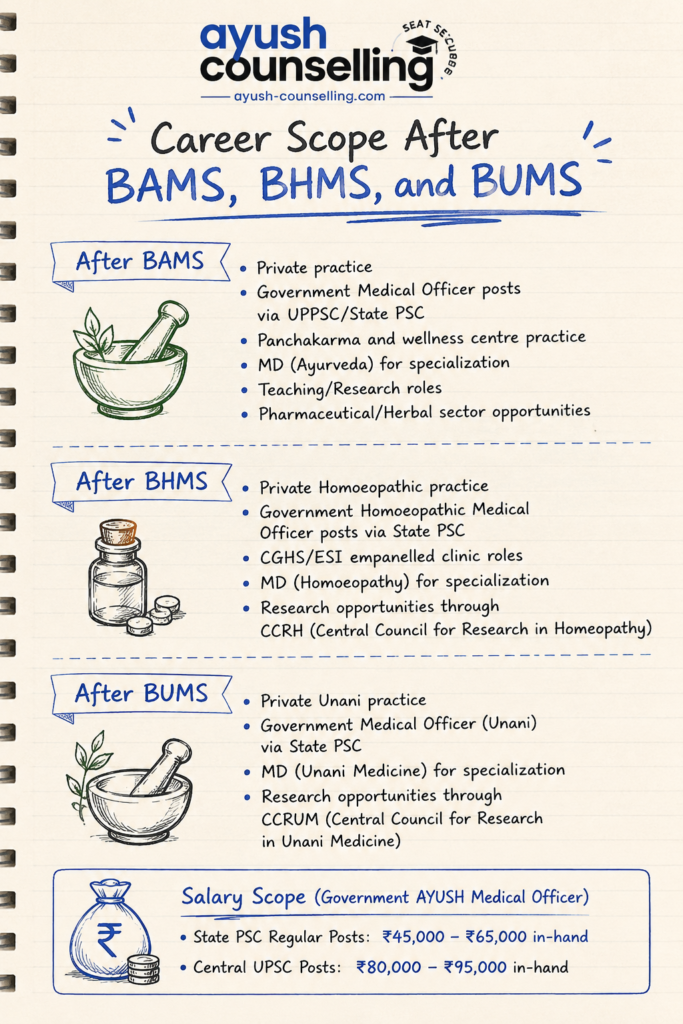
After BAMS: Private practice, government Medical Officer posts via UPPSC/State PSC, Panchakarma and wellness centre practice, MD (Ayurveda) for specialization, teaching/research roles, and pharmaceutical/herbal sector opportunities.
After BHMS: Private Homoeopathic practice, government Homoeopathic Medical Officer posts, MD (Homoeopathy), CGHS/ESI empanelled clinic roles, and research through CCRH (Central Council for Research in Homoeopathy).
After BUMS: Private Unani practice, government Medical Officer (Unani) via state PSC, MD (Unani Medicine), and research through CCRUM (Central Council for Research in Unani Medicine).
Government AYUSH Medical Officer salaries in 2026 typically range from ₹45,000–₹65,000 in-hand for state PSC regular posts, up to ₹80,000–₹95,000 for central UPSC postings.
Common Mistakes That Cost Students Their Seat
- Assuming 2025’s exact dates and cutoffs apply unchanged to 2026 — this year’s re-exam shifted the entire calendar and likely raised cutoffs across the board.
- Filling too few college preferences — a short list is pure risk with zero offsetting benefit given how the allotment algorithm works.
- Not locking choices before the deadline — treated as automatic withdrawal from that round, with no manual override.
- Paying the wrong-tier security deposit for the choices actually being filled.
- Using an outdated OBC-NCL certificate — many rounds require certificates issued within the current cycle.
- Giving up after Round 1 — UP AYUSH has historically run up to 5 stray vacancy rounds, with meaningfully lower cutoffs in later rounds.
- Registering on only one portal — missing either AACCC or state-quota opportunities by assuming one covers both.
Official Resources & Helplines
| Resource | Link |
|---|---|
| UP AYUSH Counselling Official Portal | upayushcounseling.upsdc.gov.in |
| AACCC (All India Quota) | aaccc.gov.in |
| NEET UG Result & Scorecard | neet.nta.nic.in |
| Ministry of AYUSH | ayush.gov.in |
| National Commission for Indian System of Medicine | ncismindia.org |
Always rely on these official sources for date-sensitive updates. Avoid unofficial WhatsApp forwards and social media posts for anything related to deadlines — they are a frequent, documented source of misinformation during counselling season.
Your Action Checklist Right Now
- Download and save your NEET UG 2026 Re-Exam scorecard from neet.nta.nic.in
- Confirm your category-wise percentile, not just your raw score
- Check your UP domicile status and whether you’re eligible for state-quota government seats
- Get a fresh OBC-NCL/EWS/category certificate if yours is more than a year old
- Bookmark upayushcounseling.upsdc.gov.in and check regularly through August 2026
- Decide whether you’re applying for state quota, AIQ, or both (register separately for each)
- Keep ₹2,000 (registration) + ₹20,000–50,000 (security deposit) ready
- Build a long, properly researched choice list — don’t wait until the deadline week
- Prepare 5-6 self-attested photocopies of every required document in advance
Frequently Asked Questions
Q1. When will UP AYUSH Counselling 2026 registration open?
Based on the NEET UG 2026 Re-Exam result declared July 16, 2026, registration is realistically expected in early-to-mid August 2026 — later than a typical cycle due to the re-exam delay. Confirm exact dates on upayushcounseling.upsdc.gov.in.
Q2. Why was NEET UG 2026 delayed this year?
The original May 3, 2026 exam was cancelled due to integrity concerns, and a nationwide Re-Exam was conducted on June 21, 2026, with the result declared July 16, 2026.
Q3. Is UP AYUSH Counselling 2026 more competitive than 2025?
Likely yes, at the top end — 2026’s Re-Exam produced notably higher scores (19 candidates above 700, versus effectively none in 2025), suggesting cutoffs will run higher across most categories and colleges this year.
Q4. Can a non-UP domicile student get a government AYUSH seat in UP?
Not through the 85% state quota, which requires UP domicile. Non-domicile candidates can apply for private college seats without domicile, or compete for the 15% AIQ share via AACCC, which has no domicile restriction.
Q5. What’s the difference between the registration fee and the security deposit?
The ₹2,000 registration fee is a one-time, non-refundable participation charge covering all rounds. The ₹20,000/₹50,000 security deposit is a conditionally refundable commitment amount tied to how and when you exit the process.
Q6. How many counselling rounds does UP AYUSH typically run?
Round 1, Round 2, a Mop-Up Round, and one or more Stray Vacancy Rounds — UP has conducted up to 5 stray rounds in a single admission cycle historically.
Q7. Can I apply to both AACCC and UP state counselling?
Yes. They’re entirely separate, parallel processes with independent registration, fees, and seat pools — most serious aspirants register for both.
Q7. Can I apply to both AACCC and UP state counselling?
Yes. They’re entirely separate, parallel processes with independent registration, fees, and seat pools — most serious aspirants register for both.
Q8. Is BUMS a good backup option if my score doesn’t meet BAMS cutoffs?
Yes — BUMS government college cutoffs in UP typically run somewhat lower than BAMS due to lower applicant demand, making it a realistic option for moderate scorers.
Disclaimer: This guide reflects the NEET UG 2026 Re-Exam result declared July 16, 2026, and the most recently confirmed UP AYUSH fee, seat, and reservation figures as of this update. UP AYUSH Counselling 2026 dates remain provisional until the official notification is released. Always cross-check current details directly on upayushcounseling.upsdc.gov.in and aaccc.gov.in before making any registration or payment decision.
Table of Contents
AYUSH Counselling | Core Process | AACCC
- AACCC AYUSH Counselling 2026-27: Complete Schedule, Dates & Latest Updates
- Which are the top government BAMS colleges in India? What are their exact NEET cutoffs?
- How Many AYUSH Colleges Should You Include in Your Choice List During Counselling?
- Should I Include Private and Deemed AYUSH Colleges in My Choice List?
- AIQ vs State Quota for AYUSH Seats: The Real Difference [2026]
- What NEET Rank Is Good for AYUSH Admission 2026? Complete Guide with Cutoff Scores
NEET AYUSH Cutoff & Score Analysis 2026
- AYUSH Counselling Live Status 2026
- Can I Participate in Both MBBS and AYUSH Counselling Simultaneously?
- What NEET Rank Is Good for AYUSH Admission 2026? Complete Guide with Cutoff Scores
- UP AYUSH Counselling 2026 Registration — Direct Link & Steps
- NEET 2026 Passing Marks for AYUSH — Category-Wise
- My NEET Score Is 300 — What AYUSH Options Do I Have?
Colleges Lists | Rankings | Reviews
- Ishan Ayurvedic Medical College and Research Centre, Greater Noida — BAMS Admission 2026
- Guru Gorakshanath Institute of Medical Sciences Gorakhpur — BAMS Admission & AYUSH Counselling 2026 Complete Guide
- Apex Institute of Ayurvedic Medicine & Hospital | Top College In Varanasi | 2026
- Sham-e-Ghausia Minority (SGM) Ayurvedic & Unani Medical College, Ghazipur — Complete Fee Structure Guide 2026-27
- Naiminath Homeopathic Medical College Agra — Fee Structure 2026
- Is it easier to get AYUSH admission compared to MBBS with the same NEET score?
Fees Scholarships | Financial Guidance
- Domicile Certificate for AYUSH Counselling — How to Get It
- BAMS Government College Fee Structure 2026 — State-Wise
- Private BAMS College Fees 2026 — Total Cost of 5.5 Years
- Scholarship for BAMS Students 2026 — Central & State Schemes
- Education Loan for BAMS BHMS 2026 — Banks & Process
- UP AYUSH Counselling 2026 Registration Fee & Security Deposit: Complete Fee Guide (What’s Refundable and What’s Not)