NCISM (National Commission for Indian System of Medicine) is the apex statutory and regulatory body governing Ayurveda, Unani, Siddha, and Sowa-Rigpa (AUSS) medical education in India. It replaced the old Central Council of Indian Medicine (CCIM) in 2021 and operates under the Ministry of AYUSH, Government of India. If you’re preparing for UPSC, state PSC exams, NEET AYUSH, or simply want to understand how traditional medicine education is regulated in India — this article covers everything.
Table of Contents
What Is NCISM? A Simple Explanation
India has a rich tradition of indigenous medicine systems — Ayurveda dating back thousands of years, Unani medicine brought by Persian scholars, Siddha medicine rooted in Tamil culture, and Sowa-Rigpa, the traditional medicine of Ladakh and Tibet. Each of these systems has colleges, hospitals, practitioners, and a research ecosystem. Someone has to regulate all of that.
That “someone” is NCISM.
The National Commission for Indian System of Medicine is a statutory body — meaning it was created by a specific law of Parliament, not just by government order. It sets the rules for how AYUSH colleges are opened, how students are admitted, what doctors are taught, how practitioners are registered, and how quality standards are maintained across the country.
Think of NCISM as the NMC (National Medical Commission) for traditional medicine. Just as NMC governs MBBS education and allopathic medical practice, NCISM governs BAMS, BUMS, BSMS, and other Indian medicine degree programmes.
The Law Behind NCISM — NCISM Act, 2020
NCISM was created under the National Commission for Indian System of Medicine Act, 2020, which was notified on 20 September 2020 and came fully into force on 11 June 2021. On that same date, the old Central Council of Indian Medicine (CCIM) — which had been functioning since 1971 under the Indian Medicine Central Council Act, 1970 — was officially dissolved and its powers transferred to NCISM.
The shift was significant. The CCIM had been in existence for over five decades, but it came under persistent criticism for being slow, opaque, and sometimes compromised by conflicts of interest. Members who owned AYUSH colleges could vote on matters that directly benefited their own institutions. Inspections were sometimes inconsistent. Recognition of substandard colleges was a documented problem.
The NCISM Act was designed to fix all of this — bringing in greater transparency, accountability, and uniform national standards.
When and Where Was NCISM Formally Established?
- Act passed: September 20, 2020
- Operationally active: June 11, 2021
- Headquarters: New Delhi, India
- Parent Ministry: Ministry of AYUSH, Government of India
- Official Website: ncismindia.org
- Current Chairperson: Maneesha Upendra Kothekar
- Predecessor: Central Council of Indian Medicine (CCIM)
Composition of NCISM — Who Sits on the Commission?
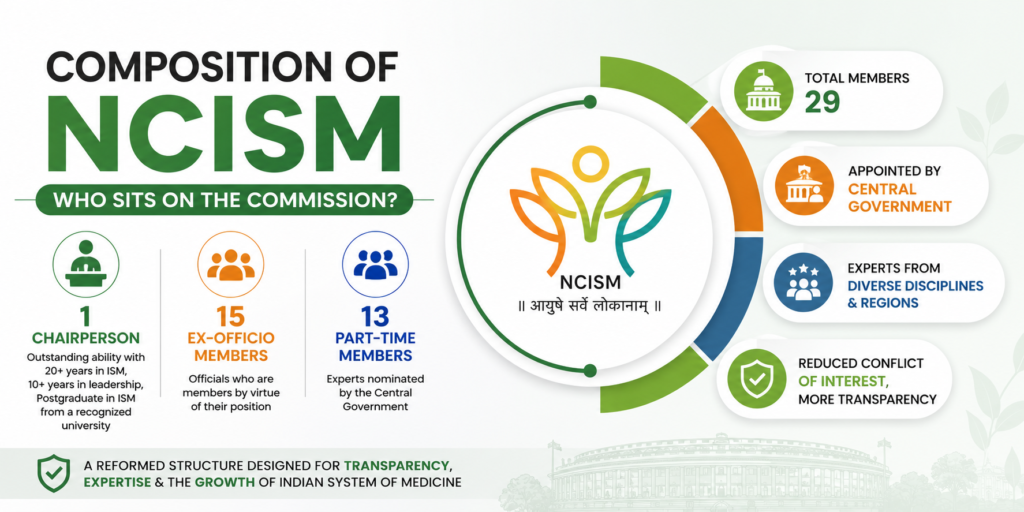
NCISM is a body of 29 members total, made up of:
- 1 Chairperson — A person of outstanding ability with at least 20 years of experience in the Indian System of Medicine, including at least 10 years in a leadership role. They must hold a postgraduate degree in any ISM discipline from a recognised university.
- 15 Ex-Officio Members — These are officials who sit on the commission by virtue of their position (like secretaries of relevant ministries, directors of national institutes, etc.)
- 13 Part-Time Members — Experts nominated by the central government, representing diversity of disciplines and regions
The Chairperson and part-time members are appointed by the Central Government. Their appointments are governed by the Act and they must be people with domain expertise — not political appointees from outside the field.
One of the most important structural changes from the old CCIM is this: NCISM significantly reduced the role of elected representatives. Under CCIM, the majority of members were elected, which opened the door to lobbying by private college owners. Under NCISM, the government-nominated structure is designed to reduce those conflicts of interest — though critics note it also reduces practitioner representation.
The Four Autonomous Boards Under NCISM
This is where NCISM gets interesting. Unlike the old CCIM which handled everything under one roof, NCISM operates through four specialised Autonomous Boards. Each Board handles specific functions for specific systems of medicine.
1. Board of Ayurveda
Handles all matters related to Ayurveda education — setting standards, approving colleges, reviewing curriculum, and maintaining quality benchmarks for Ayurveda institutions. Ayurveda is by far the largest AYUSH system in terms of colleges and students, which is why it gets a dedicated board.
2. Board of Unani, Siddha and Sowa-Rigpa
Covers the other three ISM systems under NCISM’s jurisdiction — Unani (Greco-Arabic medicine), Siddha (Tamil Nadu’s traditional medicine system), and Sowa-Rigpa (Tibetan-origin medicine practiced in Ladakh, Himachal Pradesh, Sikkim, and Arunachal Pradesh). Sowa-Rigpa was included in the ISM framework by gazette notification in 2011.
3. Medical Assessment and Rating Board for Indian System of Medicine (MARB-ISM)
This board does the inspections. It is responsible for assessing AYUSH colleges, rating them, and determining whether they meet the minimum standards to receive or continue their recognition. It grades colleges on a scale (A, B, and below) based on infrastructure, faculty, clinical exposure, OPD attendance, and outcomes like student performance in examinations. Colleges that score poorly face restrictions or can be denied permission for new admissions.
The MARB concept is a major departure from the old system. Under CCIM, inspection quality was often questioned. MARB-ISM is designed as a separate, independent body with its own mandate — so the people setting standards are not the same people doing the inspections.
4. Medical Ethics and Registration Board for Indian System of Medicine (MERB-ISM)
This board maintains the National Register of ISM Practitioners — a centralised database of all registered Ayurveda, Unani, Siddha, and Sowa-Rigpa doctors. It also handles ethical complaints against practitioners, has the authority to suspend or remove a doctor’s registration for misconduct, and oversees professional conduct standards.
A practitioner must be registered with either the National Register (via MERB) or the relevant State Medical Council to legally practice. This dual registration system ensures both national accountability and local monitoring.
Core Functions and Objectives of NCISM
Why does NCISM exist and what does it actually do day to day? Here are its core functions in plain language:
1. Setting Education Standards NCISM frames the minimum standards for AYUSH education — what a BAMS college must have in terms of faculty, hospital beds, OPD attendance, library, labs, and teaching hospitals. These standards apply at the undergraduate, postgraduate, and super-speciality levels. Without meeting these standards, a college cannot get recognition or continue operating.
2. Approving New AYUSH Colleges Any institution that wants to start a new Ayurveda, Unani, Siddha, or Sowa-Rigpa college must apply to NCISM. NCISM’s MARB-ISM board conducts a physical assessment, checks infrastructure, and gives a recommendation. Only then can a college receive Central Government approval.
In the 2025–26 academic year, NCISM took the notable step of denying permission to a significant number of substandard Ayurveda colleges — an action widely seen as evidence of stricter oversight compared to the CCIM era.
3. Framing Curriculum and Syllabi NCISM designs and updates the curriculum for all levels — BAMS, MD Ayurveda, MS Ayurveda, etc. The curriculum must balance classical Ayurvedic theory with modern scientific competencies. Staying relevant in the 21st century while preserving traditional knowledge is the ongoing challenge here.
4. Maintaining the National Register Through MERB-ISM, NCISM keeps a digitised national register of all qualified and licensed ISM practitioners. This is important both for accountability and for public access — patients can verify whether their traditional medicine doctor is legitimately qualified.
5. Research and Innovation NCISM encourages ISM professionals to adopt research practices and contribute to the evidence base for traditional medicine. A recent initiative, PRANA (Protecting Rights and Novelties in AYUSH), was organised in collaboration with AICTE and the Ministry of Education’s Innovation Cell. The conference helped ISM innovators explore patents, startups, and technology transfer — positioning Ayurveda not just as ancient wisdom but as a platform for modern healthcare innovation.
6. Coordination Among Boards and State Medical Councils NCISM acts as the coordinating umbrella — ensuring all four autonomous boards function cohesively and that state medical councils align with national guidelines. Without this coordination, you’d end up with wildly different standards between states.
NCISM vs CCIM — What Actually Changed?
Many students ask: isn’t NCISM just CCIM with a new name? The answer is no — the changes are structural, not cosmetic.
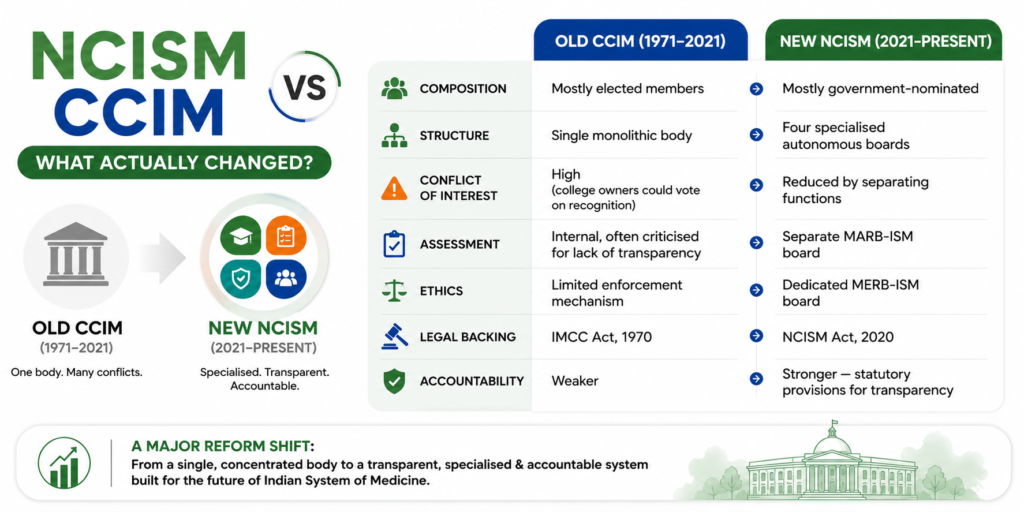
| Feature | Old CCIM (1971–2021) | New NCISM (2021–present) |
|---|---|---|
| Composition | Mostly elected members | Mostly government-nominated |
| Structure | Single monolithic body | Four specialised autonomous boards |
| Conflict of Interest | High (college owners could vote on recognition) | Reduced by separating functions |
| Assessment | Internal, often criticised for lack of transparency | Separate MARB-ISM board |
| Ethics | Limited enforcement mechanism | Dedicated MERB-ISM board |
| Legal Backing | IMCC Act, 1970 | NCISM Act, 2020 |
| Accountability | Weaker | Stronger — statutory provisions for transparency |
The NITI Aayog had specifically recommended replacing CCIM, noting that the concentration of all functions in one body made it “unwieldy and slow.” The creation of specialised, independent boards while coordinating through NCISM was a direct response to that critique.
Which Systems of Medicine Does NCISM Regulate?
NCISM’s jurisdiction covers four systems, collectively sometimes called AUSS:
- Ayurveda — Including its eight branches (Ashtanga Ayurveda): internal medicine, surgery, paediatrics, toxicology, psychiatry, ENT, rejuvenation therapy, and reproductive medicine
- Unani — Greco-Arabic traditional medicine; strong base in Uttar Pradesh, Delhi, and Kashmir
- Siddha — Tamil Nadu’s classical medicine system; emphasis on minerals, metals, and herbal preparations
- Sowa-Rigpa — Traditional medicine of Ladakh and Himalayan regions; incorporated into ISM regulatory framework since 2012
Note: Homoeopathy is NOT under NCISM. It is regulated by the National Commission for Homoeopathy (NCH), a separate statutory body under a separate act.
Recent Developments — NCISM in 2024–2025
NCISM has been actively expanding its regulatory footprint in recent years:
- Foundation Day Celebrations: NCISM celebrated its 4th Foundation Day on June 14, 2024, marking four years since the NCISM Act was passed. The event showcased progress in regulatory reforms and college assessment outcomes.
- New Office Building: Union Minister of AYUSH Sarbananda Sonowal inaugurated a new NCISM office building in New Delhi on February 7, 2024, providing the commission with a permanent institutional home.
- NCISM Minimum Essential Standards Regulations, 2024: Notified on May 13, 2024, these new regulations set upgraded standards for undergraduate Ayurveda colleges — including mandating hospital attachments scaled to intake capacity, skill labs, ICT-integrated teaching, and clearer norms around OPD attendance and bed strength.
- PRANA Conference: NCISM, AICTE, and the Ministry of Education Innovation Cell jointly organised the PRANA conference to support innovators in the Indian System of Medicine — a forward-looking step towards commercialising ISM research.
- Crackdown on Substandard Colleges: NCISM denied permissions to several Ayurveda colleges in 2025–26 that failed to meet minimum standards, marking a clear shift towards outcome-based and infrastructure-based enforcement.
Why NCISM Matters for AYUSH Students
If you’re a student who has cleared NEET 2026 and is targeting a BAMS, BUMS, or BSMS seat, NCISM directly affects your education:
- Only colleges recognised by NCISM can admit students. An unrecognised college means your degree may not be valid for licensing or government jobs.
- NCISM sets the curriculum you’ll follow in your five-and-a-half years of undergraduate training.
- Your post-qualification registration will eventually be on the National Register maintained by NCISM’s MERB-ISM board.
- If a college’s recognition is disputed or conditionally granted, NCISM’s advisory notices on its official website (ncismindia.org) are the definitive reference — always check before confirming admission.
NCISM and the AYUSH Counselling Process
NCISM does not directly conduct admission counselling — that is done by AACCC (Ayush Admissions Central Counselling Committee) for the All India Quota, and by individual state AYUSH departments for state quota. But NCISM’s role is upstream: it decides which colleges are eligible to receive admissions in the first place.
When AACCC releases its seat matrix before each counselling round, the colleges listed there are only those with valid NCISM recognition. If a college has been denied permission by NCISM for a particular academic year, it will not appear in the AACCC seat matrix — or in state quota admissions.
This is why students are often warned: always verify a college’s permission status on ncismindia.org before paying any fees or reporting to the institution.
Frequently Asked Questions About NCISM
Q: Is NCISM the same as NMC?
No. NMC (National Medical Commission) governs MBBS and allopathic medicine education under the NMC Act, 2019. NCISM governs Indian System of Medicine (Ayurveda, Unani, Siddha, Sowa-Rigpa) under the NCISM Act, 2020. Both are statutory bodies under the Ministry of Health and Ministry of AYUSH respectively, but they are completely separate.
Q: Who is the current Chairperson of NCISM?
As of 2024–2025, the Chairperson of NCISM is Maneesha Upendra Kothekar.
Q: Does NCISM regulate Homoeopathy?
No. Homoeopathy is regulated by the National Commission for Homoeopathy (NCH), a separate body under the NCH Act, 2020, which came into force alongside NCISM.
Q: What is the difference between MARB-ISM and MERB-ISM?
MARB (Medical Assessment and Rating Board) inspects and rates AYUSH colleges. MERB (Medical Ethics and Registration Board) handles practitioner registration and ethics. One deals with institutions; the other deals with individuals.
Q: Is Yoga and Naturopathy regulated by NCISM?
No. Yoga and Naturopathy (BNYS) are currently not formally included under NCISM’s regulatory jurisdiction. They operate under separate guidelines.
Summary — Key Facts to Remember
| Parameter | Detail |
|---|---|
| Full Name | National Commission for Indian System of Medicine |
| Short Form | NCISM |
| Act | NCISM Act, 2020 |
| Notified | September 20, 2020 |
| Operational | June 11, 2021 |
| Replaced | Central Council of Indian Medicine (CCIM) |
| Headquarters | New Delhi |
| Ministry | Ministry of AYUSH, Govt. of India |
| Composition | 29 members (1 Chairperson + 15 Ex-Officio + 13 Part-Time) |
| Autonomous Boards | 4 (Board of Ayurveda; Board of Unani, Siddha & Sowa-Rigpa; MARB-ISM; MERB-ISM) |
| Systems Covered | Ayurveda, Unani, Siddha, Sowa-Rigpa |
| Website | ncismindia.org |
Final Thoughts
NCISM is not just a regulatory body on paper — it is the institutional backbone of traditional medicine education in India. For a country that wants to position Ayurveda and AYUSH as credible, evidence-based healthcare systems (not just cultural heritage), having a robust, transparent regulator is foundational.
The shift from CCIM to NCISM was not just administrative housekeeping. It represented a genuine attempt to bring the same rigour and accountability to traditional medicine that the NMC Act brought to allopathic medical education. Whether it fully succeeds will depend on how effectively NCISM’s boards operate over the coming years — but the structural intent is clear.
For students, practitioners, educators, and policymakers in the AYUSH space, NCISM is the single most important institutional name to know and track.
For official notifications, college permission lists, and regulatory updates, always refer to the official NCISM website: ncismindia.org and the Ministry of AYUSH portal: ayush.gov.in.
- AACCC AYUSH Counselling 2026-27: Complete Schedule, Dates & Latest Updates
- Santushti Ayurvedic Medical College & Hospital, Mirzapur — BAMS Admission 2026: Fees, Seats, Cutoff & Full Details
- AYUSH Counselling Live Status 2026
- Ishan Ayurvedic Medical College and Research Centre, Greater Noida — BAMS Admission 2026
- Guru Gorakshanath Institute of Medical Sciences Gorakhpur — BAMS Admission & AYUSH Counselling 2026 Complete Guide
- Apex Institute of Ayurvedic Medicine & Hospital | Top College In Varanasi | 2026